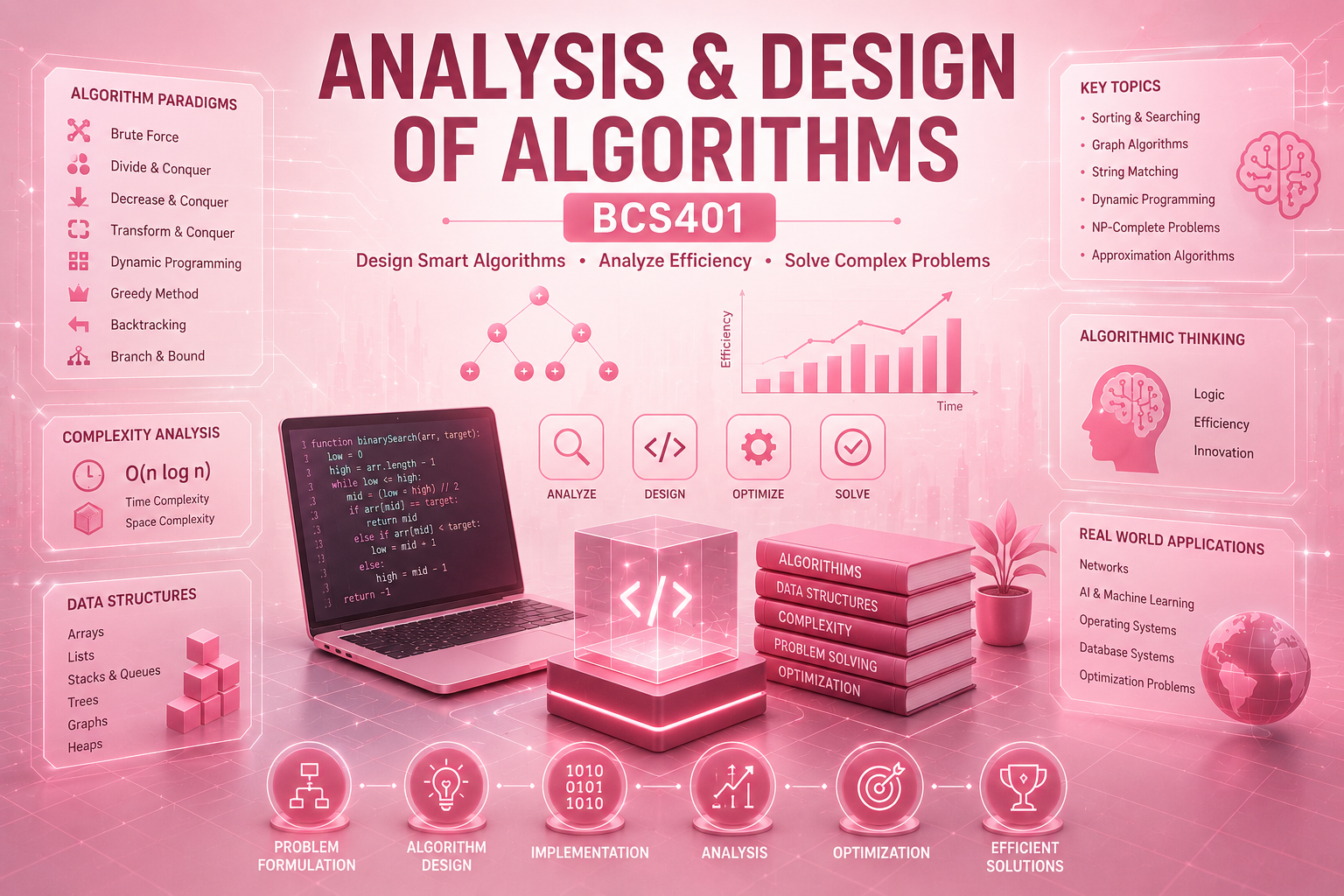
Module 1 – Introduction and Brute Force Algorithms
This module introduces the basics of algorithms and problem-solving techniques used in computer science. Students learn how to analyze the efficiency of algorithms using asymptotic notations and mathematical methods. Important sorting and searching techniques like Selection Sort, Bubble Sort, and Sequential Search are explained. The concept of brute force methods for solving problems is also introduced. Recursive and non-recursive algorithm analysis helps students understand program performance. Overall, this module builds a strong foundation in algorithm design and efficiency analysis.
Click to get the Module1
Module 2 – Decrease-and-Conquer and Divide-and-Conquer Techniques
This module focuses on advanced problem-solving strategies used in algorithm design. Students learn exhaustive search methods for problems like Travelling Salesman and Knapsack problems. Algorithms such as Insertion Sort and Topological Sorting are introduced using decrease-and-conquer techniques. Divide-and-conquer methods like Merge Sort, Quick Sort, and Binary Tree Traversals are also explained. Strassen’s Matrix Multiplication and large integer multiplication are covered for efficient computation. Overall, this module improves logical thinking and optimization skills in programming.
Click to get the Module2
Module 3 – Transform-and-Conquer and Space-Time Tradeoffs
This module explains efficient data organization and sorting techniques. Students learn balanced search trees, heaps, and heapsort algorithms used in data management. Concepts of space-time tradeoffs are introduced to improve algorithm efficiency. Counting sort and Horspool’s string matching algorithm are discussed for faster searching and sorting operations. The module helps students understand how memory and execution time affect algorithm performance. Overall, it focuses on designing efficient and optimized computational solutions.
Click to get the Module3
Module 4 – Dynamic Programming and Greedy Algorithms
This module introduces dynamic programming and greedy methods for solving complex optimization problems. Students learn important algorithms such as Knapsack, Warshall’s, and Floyd’s algorithms. Greedy techniques like Prim’s, Kruskal’s, Dijkstra’s, and Huffman coding algorithms are also covered. These algorithms are widely used in networking, graph theory, and data compression applications. The module emphasizes selecting the best possible solution step by step for efficient problem solving. Overall, it helps students develop advanced analytical and optimization skills.
Click to get the Module4
Module 5 – Limitations of Algorithms and Advanced Problem Solving
This module explains the limitations of algorithmic power and computational complexity concepts. Students learn about decision trees, P, NP, and NP-complete problems. Advanced problem-solving methods such as backtracking and branch-and-bound techniques are introduced. Problems like n-Queens, subset-sum, and knapsack are solved using these methods. Approximation algorithms for NP-hard problems are also discussed. Overall, this module helps students understand complex computational challenges and modern approaches to solving difficult problems.