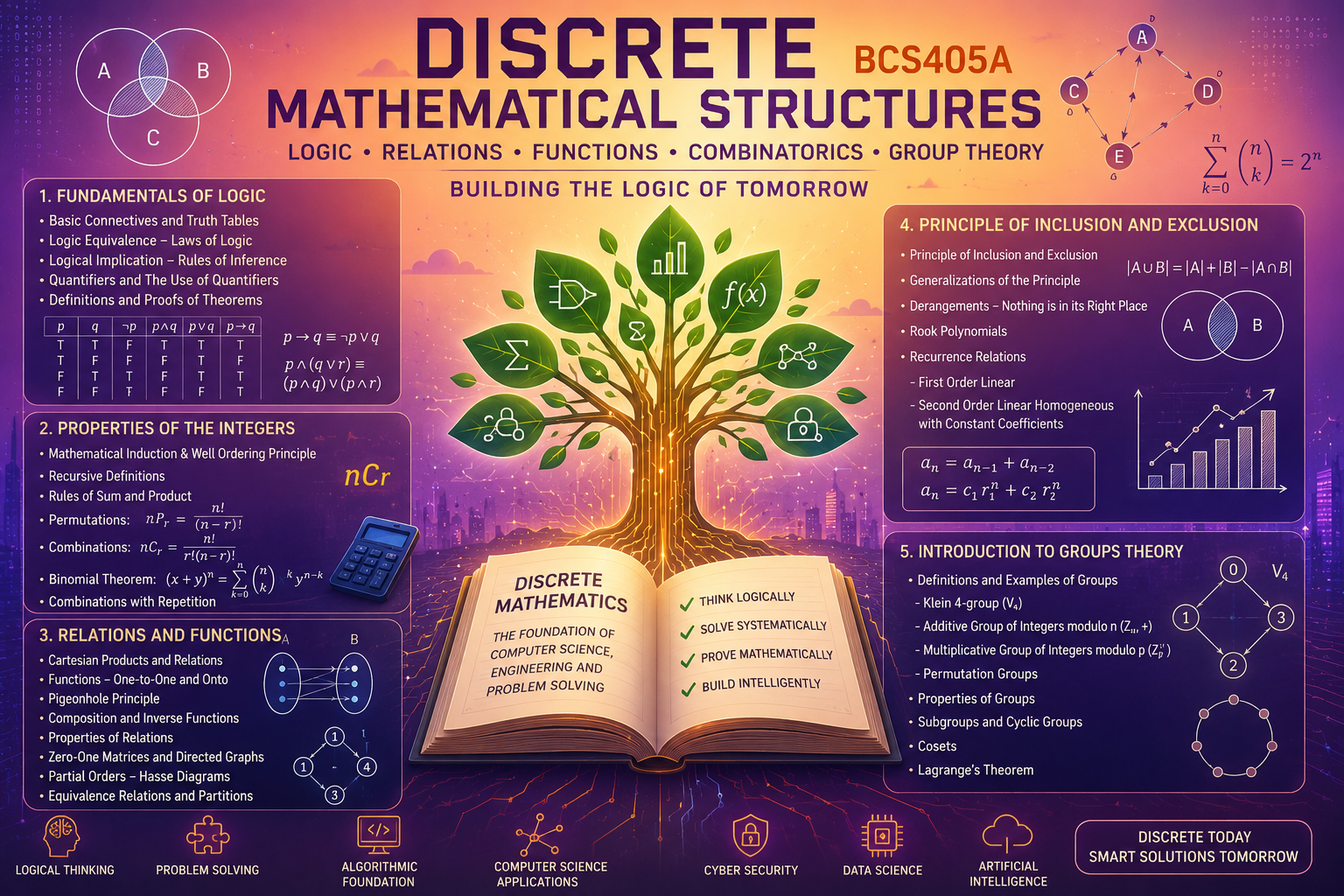
Module – 1: Fundamentals of Logic
This module introduces the basic concepts of logic used in mathematics and computer science. Students learn about logical connectives, truth tables, logical equivalence, and laws of logic. It also explains logical implications and rules of inference that help in solving logical problems. Quantifiers and theorem proving techniques are discussed to develop mathematical reasoning skills. Overall, this module builds a strong foundation for analytical and critical thinking.
Module – 2: Properties of the Integers
This module focuses on mathematical induction and recursive definitions, which are important techniques for proving mathematical statements. Students learn the well-ordering principle and how induction is used in problem solving. The module also covers counting principles such as permutations, combinations, and the binomial theorem. Concepts of combinations with repetition are introduced for advanced counting problems. These topics help students improve logical and computational thinking abilities.
Module – 3: Relations and Functions
This module explains relations, Cartesian products, and different types of functions such as one-to-one and onto functions. It introduces the pigeonhole principle and function composition concepts used in mathematics and computer science. Students also learn about matrices, directed graphs, and partial orders with Hasse diagrams. Equivalence relations and partitions are discussed for understanding structured relationships between elements. The module provides knowledge useful in algorithms, databases, and graph theory.
Module – 4: Principle of Inclusion and Exclusion
This module introduces the principle of inclusion and exclusion used in advanced counting problems. Students learn its generalizations, derangements, and rook polynomial concepts. The module also covers recurrence relations, including first-order and second-order linear recurrence relations. These concepts are important for solving sequence-based and recursive computational problems. Overall, the module develops problem-solving skills related to combinatorics and discrete structures.
Module – 5: Introduction to Group Theory
This module provides an introduction to algebraic structures called groups. It explains different types of groups such as Klein 4-group, additive and multiplicative groups, and permutation groups. Students learn properties of groups, subgroups, cyclic groups, and cosets. Lagrange’s theorem is also discussed to understand relationships between groups and subgroups. This module helps students understand abstract algebra concepts used in cryptography, coding theory, and advanced mathematics.