Module 1 – Introduction to Graphs
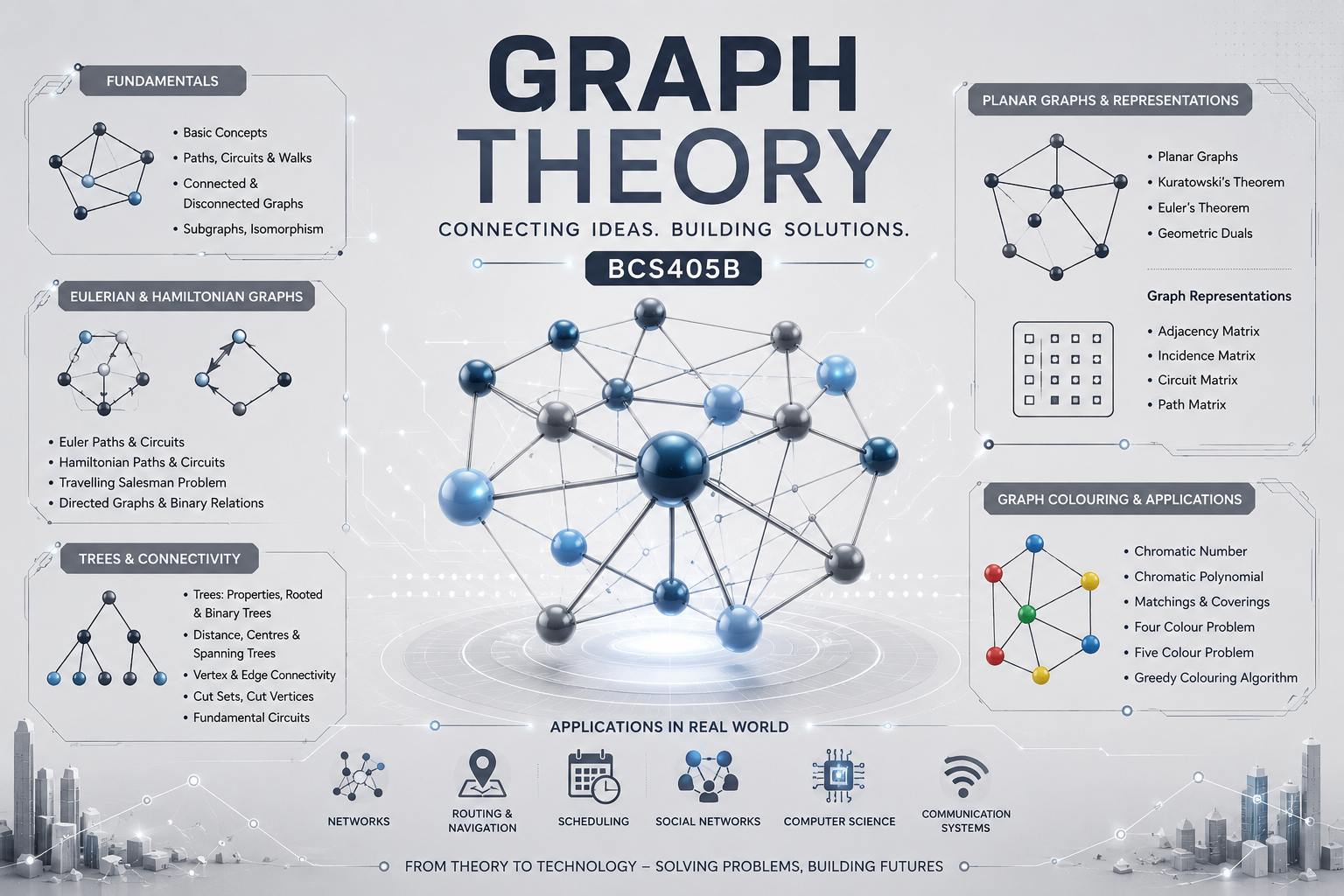
This module introduces the basics of graph theory and its importance in solving real-world problems. Students learn different types of graphs such as finite, infinite, and bipartite graphs along with concepts like vertices, edges, degree, and incidence. Important ideas such as paths, circuits, connected graphs, and components are also explained. The module helps students understand how graphs are used in networks, communication systems, and computer science applications. Concepts like graph isomorphism and subgraphs improve logical and analytical thinking. Overall, this module builds the foundation for understanding graph structures and their applications.
Module 2 – Eulerian and Hamiltonian Graphs
This module focuses on special types of graphs and their practical applications. Students learn Euler paths, Euler circuits, Hamiltonian paths, and Hamiltonian circuits in graph structures. Concepts related to the Travelling Salesman Problem are introduced to explain optimization techniques. The module also covers directed graphs and their various types. Binary relations using digraphs are explained for better understanding of relationships in networks and systems. Overall, this module helps students analyze routing, navigation, and optimization problems using graph theory.
Module 3 – Trees and Connectivity Graphs
This module explains tree structures and graph connectivity concepts. Students learn properties of trees, rooted trees, binary trees, and spanning trees used in data organization and networking. Concepts like distance, centers in trees, and counting trees are also discussed. The module further introduces vertex connectivity, edge connectivity, cut vertices, and cut sets in graphs. Fundamental circuits and graph reliability concepts are explained clearly. Overall, this module helps students understand efficient network design and hierarchical data structures.
Module 4 – Planar Graphs and Graph Representations
This module introduces planar graphs and methods of representing graphs mathematically. Students learn Euler’s theorem, planar graph properties, geometric duals, and Kuratowski’s theorem. Different graph representation methods such as adjacency matrix, incidence matrix, circuit matrix, and path matrix are explained. These representations help in solving graph problems efficiently using computational techniques. The module highlights how graphs can be visualized and analyzed in engineering and computer applications. Overall, it improves students’ understanding of graphical data representation and analysis.
Module 5 – Graph Colouring and Applications
This module focuses on graph colouring techniques and optimization problems. Students learn concepts like chromatic number, chromatic polynomial, matchings, and coverings in graphs. Famous problems such as the Four Colour Problem and Five Colour Problem are also discussed. The greedy colouring algorithm is introduced for efficient graph colouring solutions. Applications of graph colouring in scheduling, map colouring, resource allocation, and network design are explained. Overall, this module helps students understand practical problem-solving techniques using graph theory concepts.