Module – 1: Vector Calculus
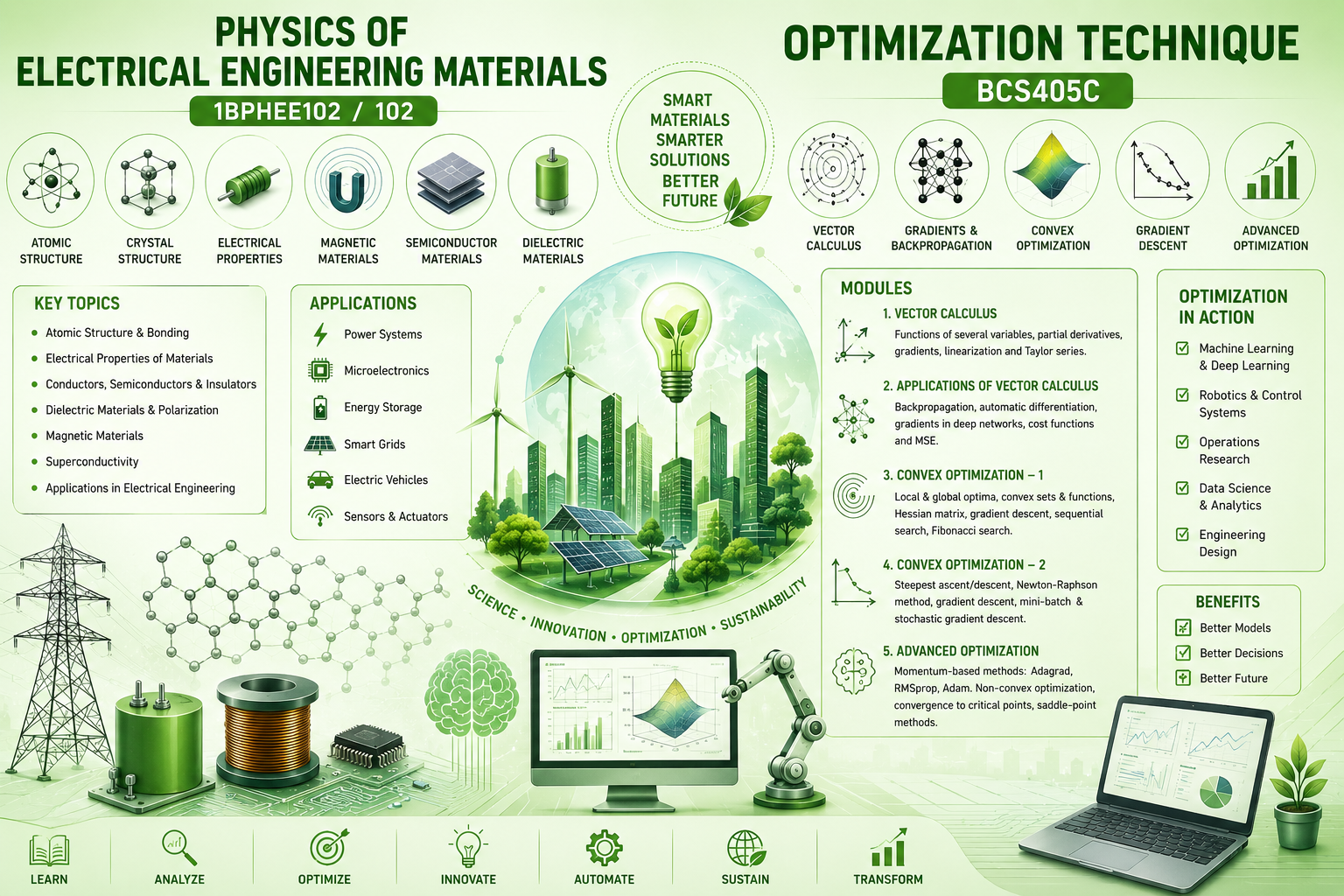
This module introduces the fundamentals of vector calculus and functions involving multiple variables. Students learn about differentiation, partial derivatives, gradients, and vector-valued functions used in mathematical modeling and machine learning. It also explains gradients of matrices and useful mathematical identities for simplifying calculations. Concepts like linearization and multivariate Taylor series help in approximating complex functions. Overall, this module builds the mathematical foundation required for optimization and deep learning techniques.
Module – 2: Applications of Vector Calculus
This module focuses on how vector calculus is applied in machine learning and neural networks. Students learn about backpropagation and automatic differentiation, which are essential for training deep learning models. The module explains gradients in deep networks and how cost functions are minimized using optimization methods. Concepts such as Mean Squared Error (MSE) and quadratic cost gradients are discussed in detail. This module helps students understand how mathematical concepts are used in real-world AI and data science applications.
Module – 3: Convex Optimization – 1
This module introduces the basic concepts of convex optimization and mathematical optimization techniques. Students learn the difference between local and global optima and study convex sets and convex functions. The role of the Hessian matrix in optimization problems is also explained. Optimization techniques such as gradient descent, sequential search, three-point search, and Fibonacci search are covered to improve solution-finding methods. This module provides a strong understanding of solving optimization problems efficiently.
Module – 4: Convex Optimization – 2
This module focuses on unconstrained optimization techniques used in machine learning and engineering applications. Students learn methods such as steepest ascent and descent, Newton-Raphson method, and gradient descent optimization. The module also introduces mini-batch gradient descent and stochastic gradient descent, which are widely used in training large-scale machine learning models. These techniques help improve the speed and accuracy of optimization processes. Overall, the module strengthens practical knowledge of modern optimization algorithms.
Module – 5: Advanced Optimization
This module covers advanced optimization techniques used in deep learning and artificial intelligence. Students learn momentum-based optimization methods such as Adagrad, RMSprop, and Adam, which improve learning efficiency in neural networks. The module also explains non-convex optimization and methods for handling critical points and saddle points. These concepts are important for solving complex real-world optimization problems. This module gives students practical insight into advanced AI optimization methods used in modern technologies.